Choosing a reliable Travel Tumbler manufacturer in China requires more than comparing prices. Buyers must examine materials, factory capability, testing records, and communication quality. A polished product photo proves very little. The real evidence appears in samples, inspection reports, and production details.
Beth Terry, author of Plastic-Free and a respected reusable-product advocate, has said, “The most important thing is to use what you already have.” Her point matters here. A durable tumbler should survive repeated journeys, not become another discarded item after a few months. This guide examines Chinese manufacturers through that practical lens. It considers stainless-steel grades, vacuum insulation, lid design, leak resistance, coating quality, and packaging choices. Small details matter. A weak silicone seal can soak a laptop bag. A poorly fitted lid can ruin a morning commute.
China remains a major manufacturing hub for insulated drinkware, but factory quality varies widely. Some suppliers operate automated welding lines and controlled testing rooms. Others depend heavily on manual assembly. That difference may not appear in a catalog. It often appears after the first bulk shipment. We will compare leading manufacturers by product consistency, customization support, compliance documentation, minimum order quantities, and export experience. The ranking is not absolute. A premium brand may suit one buyer, while a flexible factory may better serve another. Even this approach has limits. Public supplier information can change, and independent verification remains necessary. A careful buyer should request current samples, audit evidence, and clear written specifications before making a decision.
What defines a top China travel tumbler manufacturer? It is not only factory scale or a low quotation. Grand View Research reports that the global reusable water bottle market reached about USD 8.9 billion in 2023, with continued growth expected through 2030. This demand rewards suppliers that combine stable production, safe materials, and dependable delivery. A serious manufacturer should explain its stainless-steel grade, liner process, vacuum insulation method, and leak-testing standard without vague claims.
Evidence matters.
During supplier evaluation, request production records, material certificates, and test results from independent laboratories. Useful checks include food-contact safety, lead and heavy-metal limits, thermal retention, pressure resistance, coating adhesion, and dishwasher durability. ISO 9001 certification can indicate process control, but it does not automatically prove product quality. The same applies to attractive factory videos. They show little about rejected units, corrective actions, or batch traceability.
A capable manufacturer should provide a sample made on the intended production line, not a hand-finished prototype. Inspect the lid threads, silicone seal, weld marks, powder coating, and mouth comfort. Ask how many units are inspected per batch and how defects are recorded. The International Trade Centre’s trade data also shows China’s continuing strength in manufactured consumer goods, yet export experience varies widely among factories. That difference is easy to miss. A top supplier communicates risks early, documents changes, and accepts reasonable third-party inspection. Still, no factory is perfect; even strong systems can fail when designs change too quickly or quality checks become routine.
China’s leading travel tumbler manufacturers are concentrated in several industrial regions, not one single city. Yongkang in Zhejiang is well known for stainless-steel hardware and metal drinkware production. Many factories there handle forming, welding, polishing, vacuum insulation, and surface finishing in nearby facilities. This short supply chain can improve communication and reduce transport between production stages.
Ningbo and Yiwu, also in Zhejiang, support tumbler production through export services, packaging suppliers, mold workshops, and shipping networks. Guangdong, including areas around Dongguan and Shenzhen, offers strong capabilities in plastic components, electronic accessories, and customized packaging. Jiangsu and Fujian also contain capable factories, especially for stainless-steel processing and mass production. However, location alone does not prove quality. A factory may outsource key processes, which can affect consistency. That detail is easy to miss.
Tips: Ask for the exact factory address, production photos, and a clear process list. Check whether vacuum testing, leak testing, and coating inspection happen onsite. Request recent samples before discussing large orders. A video tour helps, but it is not perfect evidence. In-person or independent audits remain more reliable.
Buyers should compare factories by manufacturing depth, inspection records, export experience, and response speed. A supplier near a major port may offer convenient shipping, but a specialized inland factory might provide better technical control. The right choice depends on design complexity, order volume, and required finish. Even experienced sourcing teams should leave room for verification. Mistakes often begin with assumptions.
Which China Travel Tumbler Manufacturers Are Worth Considering?
The most worthwhile China travel tumbler manufacturers show consistent control, not only attractive catalogs. During supplier evaluations, I examine stainless steel grades, lid construction, vacuum insulation, and welding quality. A reliable factory should provide material records and recent test results. Ask for samples before discussing large orders. Small details matter, such as a smooth thread, firm silicone seal, and a cup that fits standard vehicle holders.
Factory experience also deserves attention. Manufacturers serving outdoor, hospitality, or promotional markets often understand different usage conditions. Check their production equipment, inspection process, and monthly capacity. A short video call can reveal useful details, including warehouse organization and packaging methods. However, polished presentations can hide weak quality control. Do not rely on photos alone.
Communication is another practical test. Strong manufacturers answer technical questions clearly and explain limitations honestly. They should discuss minimum order quantities, sample fees, lead times, and customization risks. Test the tumbler repeatedly with hot and cold liquids. Check leakage after transport simulation. No factory is perfect. I once overlooked a slightly loose lid because the sample looked excellent. That mistake changed my evaluation process. Now, I value documented inspections, responsive problem-solving, and stable quality more than the lowest quotation. A manufacturer worth considering should make its process understandable, measurable, and open to review.
When comparing China travel tumbler manufacturers, buyers commonly prioritize product quality, insulation performance, customization capability, compliance documentation, and delivery reliability. The chart shows a practical reference weighting for evaluating suppliers; it does not represent data from any specific company or brand.
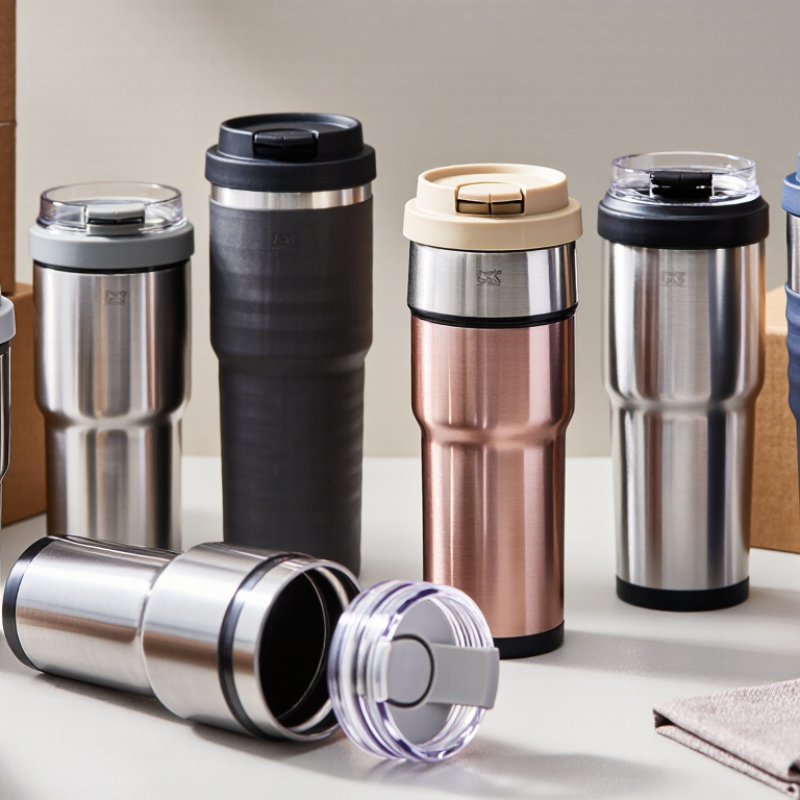
China’s travel tumbler manufacturers typically supply stainless-steel, double-wall vacuum, plastic, and ceramic-coated models. Common sizes range from 12 to 40 ounces. Many factories offer leak-resistant lids, sliding covers, silicone seals, handles, straws, and car-cup compatibility. Some also produce coffee tumblers, thermal bottles, and stackable office cups.
Customization is usually the stronger advantage. Buyers can request powder coating, spray painting, laser engraving, silk printing, embossing, custom colors, and retail packaging. Manufacturers may also adjust lid structures, insulation thickness, grip texture, and logo placement. Grand View Research estimated the global reusable water bottle market at about USD 9.07 billion in 2023. Its projected growth suggests continuing demand for durable, reusable drinkware. This supports investment in practical customization, not decoration alone.
Quality control should include vacuum retention, leakage, coating adhesion, odor, and material testing. Food-contact documentation matters, especially for export orders. The U.S. Food and Drug Administration regulates materials intended to contact food, while European buyers often request testing aligned with EU food-contact requirements. A factory may provide test reports, production samples, and inspection records. Still, paperwork is not proof of every shipment’s quality. A perfect sample can hide inconsistent welding or weak seals in mass production. Buyers should inspect random units and confirm tolerances before approval. Small details matter. A lid that drips in a commuter’s bag can damage trust quickly.
Choosing the right Chinese tumbler manufacturer requires more than comparing prices. A polished showroom is not proof. Buyers should inspect factory capability, production records, and quality controls. Ask whether the facility produces stainless steel tumblers regularly or only trades them. Request recent photos of welding, polishing, powder coating, and packing areas. A live video audit can reveal crowded workstations, weak storage practices, or unclear material flow. These small details matter.
Order samples from the same production line used for bulk orders. Check lid alignment, thread smoothness, coating consistency, and leakage after repeated opening. Test heat retention with a controlled method, not casual hand checks. Request material documentation, food-contact test reports, and inspection records from qualified laboratories. Confirm whether the documents match the actual product and factory. Sometimes they do not. That deserves a clear explanation.
Reliable manufacturers should provide traceable batch numbers, written specifications, and realistic lead times. Discuss minimum order quantities, replacement procedures, packaging strength, and change approval before signing. A low quote may exclude mold fees, testing, or export packaging. Calculate the complete landed cost. Communication also needs testing: send a detailed drawing and observe how carefully the supplier responds. Vague answers can become expensive mistakes. Still, no audit is perfect. Keep an independent pre-shipment inspection for the first orders, even when the factory appears experienced.
A reliable manufacturer shows stable production, safe materials, and dependable delivery. It explains steel grades, liner processing, vacuum insulation, and leak testing clearly. Vague claims are not enough.
Request material certificates, production records, and recent laboratory test results. Check food-contact safety, heavy-metal limits, thermal retention, and pressure resistance. Documents matter.
No. It may indicate process control, but it does not prove every tumbler is safe or durable. Review batch records and inspection results too.
Yes. Request a sample made on the intended production line. Inspect lid threads, silicone seals, weld marks, coating, and mouth comfort. Hand-finished samples can hide production problems.
Fill it with hot and cold liquids repeatedly. Check leakage after transport simulation and inspect the lid after several openings. A cup should fit standard vehicle holders.
Review production equipment, inspection methods, monthly capacity, warehouse organization, and packaging. Ask how many units are checked per batch. Also ask how defects are recorded.
Strong suppliers answer technical questions directly and explain limitations honestly. They discuss minimum order quantities, sample fees, lead times, and customization risks. Clear communication helps.
No. Videos may not show rejected units, corrective actions, or batch traceability. A brief live call can reveal packaging and warehouse details, but it is still imperfect evidence.
Do not choose only by the lowest quotation or a beautiful sample. I once ignored a slightly loose lid because the sample looked excellent. That mistake changed my inspection process.
China’s top Travel Tumbler manufacturers are defined by consistent product quality, reliable production capacity, strong material control, and professional communication. Many leading factories are located in established manufacturing regions with well-developed supply chains for stainless steel, plastics, packaging, and accessory production. These locations allow manufacturers to coordinate efficiently, control costs, and support both standard and customized orders.
Buyers may find manufacturers offering insulated tumblers, leak-resistant lids, reusable bottles, different sizes, colors, finishes, and packaging options. Customization services can include logo application, color matching, structural adjustments, gift packaging, and product development support. To choose the right supplier, buyers should compare certifications, sample quality, minimum order quantities, production timelines, quality-control procedures, pricing, and after-sales communication. A careful evaluation of factory capabilities and customization requirements can help buyers build a stable supply relationship and select a manufacturer that meets their quality, design, and delivery expectations.

Yongkang Yifu